 EN · United States
AI in lending has moved from pilots to production. An industry tracker updated on 16 October lists 44 banks using AI in at least one lending step in production, among them Citi, Synchrony, TD Bank and KeyBank, with 16 more rolling it out and 8 in pilots. At the same time, a PYMNTS piece citing a law firm warns that AI tools now score borrowers, read financial statements and write first drafts of credit memos, often without anyone at the bank formally approving the change.
Where AI sits in the credit process today
- Reading documents: bank statements, payslips, financial statements and IDs.
- Scoring and ranking applications, and flagging possible fraud.
- Drafting credit memos and decision summaries for underwriters.
- Prioritising collections and preparing borrower conversations.
Why governance is the real issue
Regulators have been asking banks about vendor controls, model monitoring and the ability to switch an AI component off. Mortgage lenders are scaling AI more slowly than other financial firms, according to a Mortgage Bankers Association study published in early October, partly for the same reason: it is hard to prove who is responsible for a decision a model helped to make.
Five rules that keep AI in credit under control
- AI proposes, a person decides on anything outside clear rules.
- Every AI step is logged with its input, output and reason, like a staff action.
- Each agent has a role with limited data and actions, and can be switched off at once.
- New models run next to the current process on past cases before they go live.
- Model quality is checked against real outcomes, with alerts when it drifts.
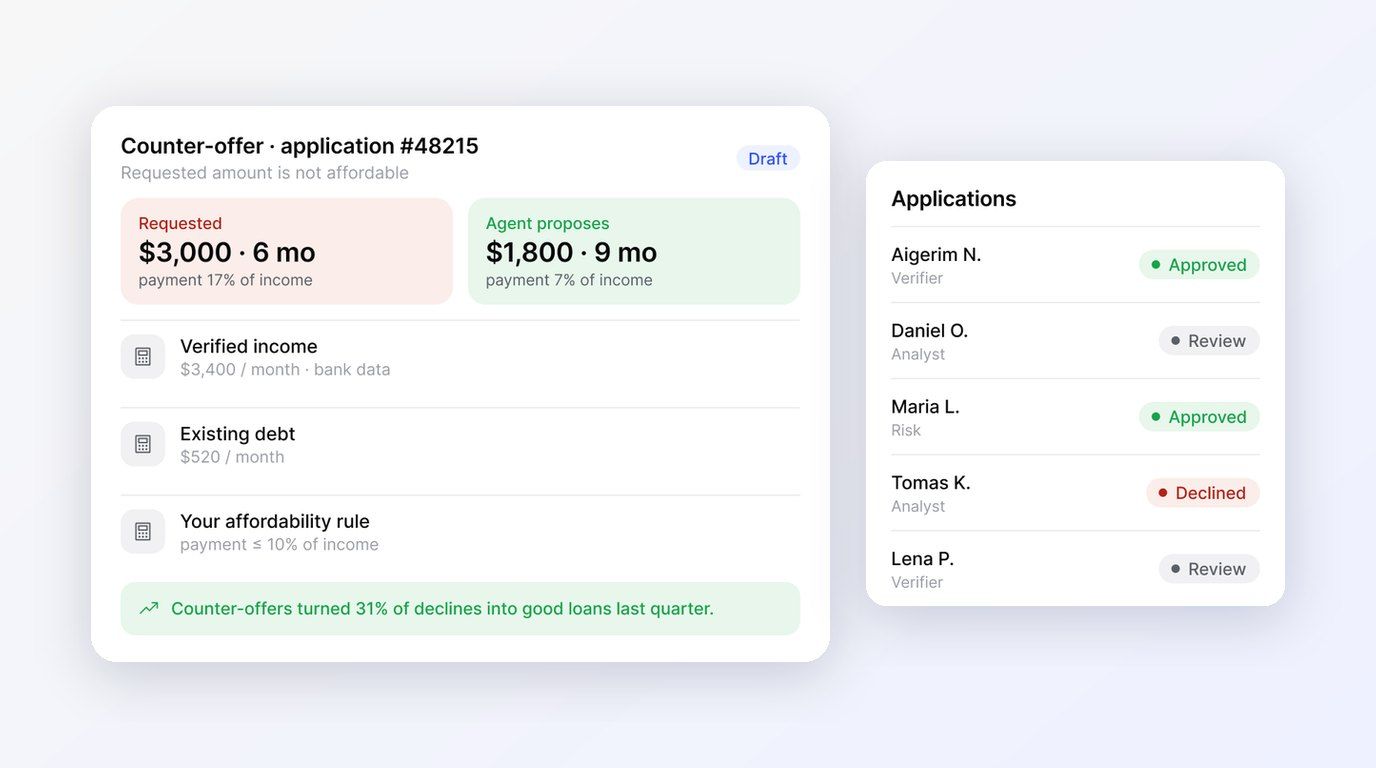
These are the rules lendhero’s AI agents follow: the underwriter agent drafts a decision with reasons, every action is logged and the lender’s team keeps the final word.
Sources: BankingNewsAI tracker, PYMNTS, MPA, Inside Mortgage Finance.
lendhero solutionUnderwriter agentPrepares borderline cases and proposes a decision with reasons.